
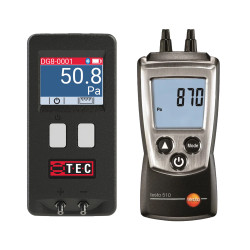
Pressure Manometers
Differential Pressure Manometers for HVAC & Building Performance Testing
Measure static pressure, filter pressure drop, duct leakage, and pressure-based airflow calculations with a professional-grade differential pressure manometer. TruTech Tools stocks digital and analog models from Fieldpiece, UEi, and Dwyer - trusted by HVAC technicians and building performance professionals for accurate, repeatable field measurements. Whether you need a pocket-sized manometer for quick filter checks or a dual-port digital gauge for full system diagnostics, we carry the right tool for the job.
What is static pressure in HVAC systems?
Static pressure refers to the resistance to airflow in a duct system. High static pressure can indicate blocked filters, restrictive ductwork, or undersized returns, while low static pressure may point to leaks or improper system design.
Common Uses for Differential Pressure Manometers
Differential pressure manometers are essential diagnostic tools for HVAC technicians. They are commonly used for:
- Measuring total external static pressure (TESP) in residential and commercial HVAC systems
- Checking pressure drop across air filters to determine if replacement is needed
- Evaluating coil performance by measuring pressure drop across evaporator and condenser coils
- Diagnosing airflow restrictions caused by duct design, blockages, or undersized returns
- Testing gas pressure and manifold pressure in heating systems
- Measuring differential pressure in ventilation systems and air balancing applications
- Calculating air velocity and airflow when used with pitot tubes and probes
How do you measure static pressure with a manometer?
To measure static pressure, connect the manometer probes to the supply and return sides of the system using static pressure tips. The tool will display the pressure difference, helping you evaluate system performance and airflow conditions.
What is the difference between a manometer and a pressure gauge?
A manometer measures pressure differences or low-pressure readings with high precision, making it ideal for HVAC diagnostics. A pressure gauge typically measures single-point pressure and is more commonly used for higher-pressure systems like refrigeration or gas lines.
What units do HVAC manometers use?
Differential pressure manometers typically display readings in inches of water column (inWC), pascals (Pa), or millibar (mbar). HVAC static pressure measurements are most often expressed in inches of water column.
Do I need a digital or analog manometer?
Digital manometers are more common for HVAC work because they are faster to read, more accurate, and often include additional features like data logging, dual-port measurements, and Bluetooth connectivity. Analog models are less common but can be used for basic applications.
Why is measuring pressure drop across a coil or filter important?
Measuring pressure drop helps identify airflow restrictions that reduce system efficiency. A high pressure drop across a coil or filter can indicate buildup, improper sizing, or the need for replacement.
Can a manometer measure airflow?
A manometer does not directly measure airflow, but it can be used with accessories like pitot tubes to calculate air velocity and airflow based on pressure readings.
What should static pressure be in a typical HVAC system?
Most residential HVAC systems are designed for a total external static pressure (TESP) of around 0.5 inWC, but acceptable values vary by manufacturer and system design. Always compare readings to the equipment specifications.