



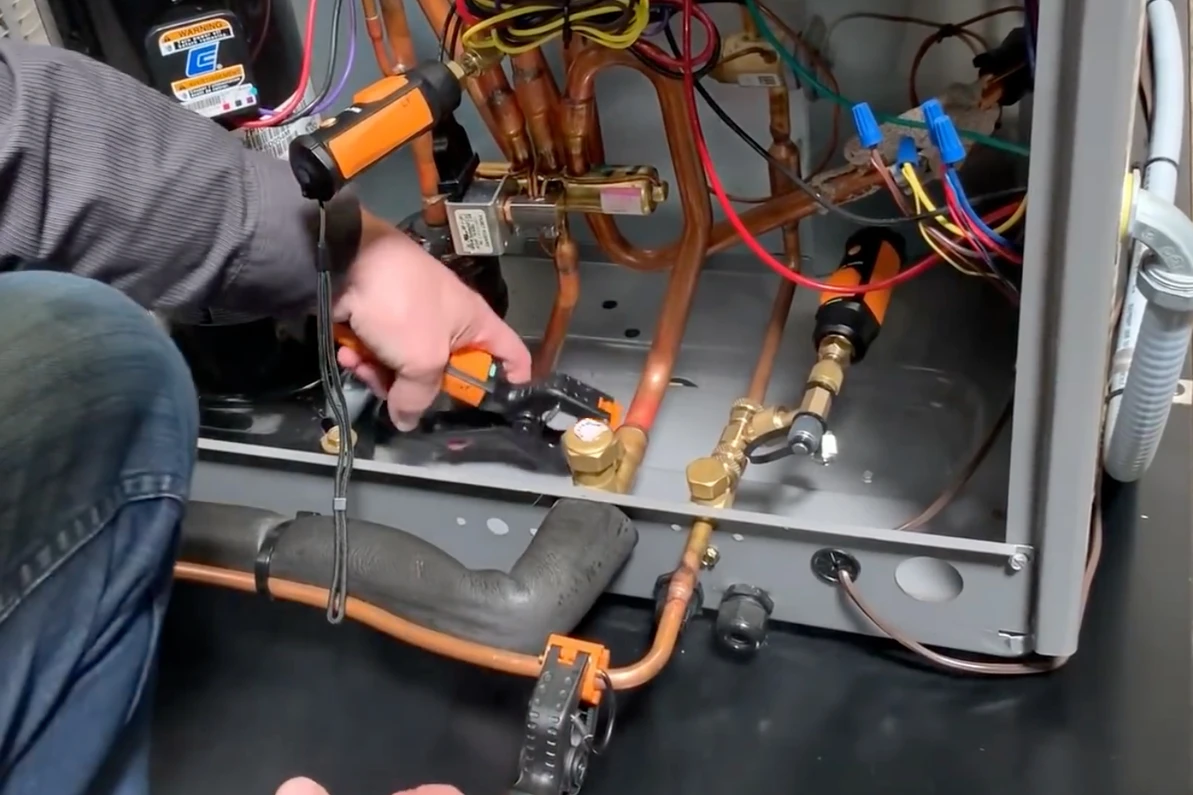
5 Essential HVAC Tools Technicians Reach for Every Day
Every technician has favorite tools, but some get used on nearly every service call. I don’t mean the specialty stuff that lives in the bottom of the van for the one job a year. These are the ones that come out of the bag before you even know what you are walking into. Whether you're troubleshooting an electrical issue, measuring refrigerant pressures and temperatures, pulling a vacuum, or opening equipment panels, certain tool categories are part of routine HVAC service work.
1. A True RMS Clamp Meter for Electrical Troubleshooting
A clamp meter is one of the most frequently used diagnostic tools in HVAC. It measures electrical values such as voltage, current, resistance, capacitance, and continuity, plus microamps DC for flame rectification and inrush current for compressor starting draw, helping technicians troubleshoot equipment before replacing components.
A True RMS meter is especially useful when working on modern HVAC equipment with variable-speed motors and electronic controls because it provides accurate measurements on non-linear electrical waveforms. An averaging meter reads those waveforms wrong, and you can end up chasing an amp draw the equipment never actually had.
The Fieldpiece SC440 True RMS HVAC Clamp Meter is one example designed specifically for HVAC work. It combines the electrical measurements technicians use most often into one compact instrument.
Field example: The thermostat is set to cool, but the condenser doesn't start. The technician verifies line voltage, checks the contactor, tests the capacitor, and measures compressor current before identifying the failed component. Two ways to check it, and which one depends on whether the unit is running. Under load, clamp the start wire and read volts across the capacitor, then microfarads equals amps times 2652 divided by volts. Take that one when you can get it, because it tests the capacitor at real operating conditions. Skip it on blower caps, since the leads can find the blower wheel. Bench test is power off, discharge, both leads off, meter across the terminals.
Why technicians rely on it
- Supports electrical troubleshooting on many service calls
- Combines multiple electrical measurements in one instrument
- Helps identify failed components before replacing parts
- Reads microamps DC for flame rectification, so the same meter can be used in heating season
2. Wireless Pressure and Temperature Probes for Refrigerant Measurements
Pressure and temperature measurements are essential for evaluating refrigeration system performance. Wireless probes allow technicians to collect those measurements while moving freely between the indoor and outdoor equipment.
Compared with traditional gauge manifolds, wireless probes reduce hose clutter and make it easier to compare refrigerant measurements with indoor airflow and temperature readings. The bigger one is refrigerant loss. The pressure probes thread straight onto the Schrader with no hoses at all, so you are not blowing off a little charge every time you hook up and break down.
The TruTech Tools Testo Professional Smart Probe Kit for measureQuick measures refrigerant pressure and pipe temperature while calculating superheat and subcooling in the accompanying app. It adds air temperature and humidity on top of that, and it works with measureQuick, so these probes run alongside compatible probes from other manufacturers instead of locking a tech into one brand.
Field example: After replacing an evaporator coil, the technician leaves the probes connected outdoors while checking supply and return temperatures indoors. Pressure and temperature readings remain available without repeated trips to the condenser.
Why technicians rely on them
- Monitor live pressure and temperature readings
- Compare refrigerant measurements with indoor conditions
- Reduce trips between the indoor and outdoor units
- Connect directly to the service port with no hoses, which cuts the refrigerant lost on every connection
- Testo Smart Refrigerant Probes in use
3. A Valve Core Removal Tool for Sealed-System Service
Whenever the refrigeration circuit is opened for repair, evacuation follows. Removing the Schrader valve cores creates a larger opening through the service ports, reducing restriction during evacuation and charging. Appion puts numbers on it. A valve core can block up to 90 percent of the access port, and evacuating through a core and depressor can drop the usable flow of any pump to as little as 0.2 CFM. That is the reason the cores come out, not a vague claim that it is faster.
The NAVAC NVR2 2-in-1 Valve Core Removal Tool is one example that allows technicians to remove and reinstall valve cores while maintaining control of the system. It fits both 1/4 inch and 5/16 inch flare.
Field example: After replacing a filter drier, the technician removes both valve cores before beginning evacuation. The larger opening allows air and moisture to move through the system with less restriction.
Why technicians rely on it
- Reduces flow restriction during evacuation and charging
- Removes and reinstalls valve cores without recovering refrigerant
- Supports efficient sealed-system service
4. A Micron Gauge for Verifying Evacuation
Pulling a deep vacuum is only part of the evacuation process. A vacuum pump removes air and moisture from the system, but it doesn't tell you when the evacuation is complete. That's the job of a micron gauge.
A micron gauge measures the level of vacuum inside the refrigeration system. It confirms that the target vacuum has been reached and verifies the system holds that vacuum during a decay test before refrigerant is added.
For accurate readings, the micron gauge should be connected on the system side of the valve core removal tool rather than at the vacuum pump. Measuring at the system confirms the condition of the refrigeration circuit itself, not just the pump and hoses.
Field example: After replacing a compressor, the technician evacuates the system to the target micron level. The valve core removal tool is closed to isolate the system while the micron gauge remains connected on the system side. If the vacuum holds during the decay test, the system is ready for charging.
Why technicians rely on it
- Confirms the target vacuum has been reached
- Verifies the system holds vacuum during a decay test
- Measures vacuum on the system side of the refrigeration circuit
- Confirms evacuation is complete before charging begins
5. A Multi-Bit Flip Bit for Everyday Equipment Access
Not every frequently used HVAC tool is a measuring instrument. Technicians remove and reinstall equipment panels throughout the day during maintenance, troubleshooting, and repairs.
A multi-bit driver reduces the number of individual nut drivers and screwdrivers needed for common HVAC fasteners. So this is actually a bit, not a driver. It goes in an impact, a drill, or a bit handle. Malco sells the Connext3 handle if you want the manual option.
The Malco MTP2 7-in-1 C-RHEX Flip Bit combines three reversible sockets covering six hex sizes, 1/4, 5/16, 11/32, 3/8, 7/16, and 1/2 inch, plus a #2 Phillips driver head built into the shaft. That is where the seven comes from.
Field example: During a maintenance visit, the technician removes the condenser panel, opens the electrical compartment, and accesses the blower section. One flip bit handles the different fasteners without switching between several tools. Time savings is close to a wash either way. Flipping the socket around lands about even with reaching for another nut driver, so the honest reason to carry it is bag space.
Why technicians rely on it
- Carries several common driver sizes in one tool
- Reduces tool changes during routine work
- Saves space in the tool bag
- Impact rated, so it holds up in a driver instead of only a hand handle
Preguntas frecuentes
- What HVAC tools do technicians use every day?
Most HVAC technicians rely on a core group of tools that includes a clamp meter, pressure and temperature probes, valve core removal tools, a micron gauge, and hand tools. The exact tool kit depends on the type of work they perform.
- Why is a True RMS clamp meter important for HVAC work?
A True RMS clamp meter provides accurate electrical measurements on the types of waveforms commonly found in modern HVAC equipment, including systems with variable-speed motors and electronic controls. An averaging meter reads those distorted waveforms wrong, which can send you after a reading the equipment never had.
- Why do technicians remove valve cores before evacuation?
Removing the Schrader valve cores creates a larger opening through the service ports. This reduces flow restriction and helps air and moisture leave the system more efficiently during evacuation. Appion's published figures: a core can block up to 90 percent of the port, and evacuating through a core and depressor can cut usable pump flow to as little as 0.2 CFM.
- Why are wireless pressure and temperature probes becoming more common?
Wireless probes allow technicians to monitor refrigerant measurements while moving between the indoor and outdoor equipment. They also reduce hose clutter and make it easier to compare refrigerant measurements with indoor conditions. The pressure probes also thread straight onto the service port with no hoses, so there is less refrigerant lost on every connection.
- What's the difference between a valve core removal tool and a vacuum-rated valve core removal tool?
Both tools remove and reinstall Schrader valve cores. A vacuum-rated model is designed to maintain a sealed connection during deep evacuation, allowing technicians to isolate the system and perform a vacuum decay test before charging.
- Do I still need a micron gauge if I have a valve core removal tool?
Yes. The core tool gets you the flow and the isolation. The micron gauge is what tells you where the vacuum actually is, and it needs to read on the system side of the core tool, not down at the pump.
Publicaciones recientes
-

Stop Feeding Google Bad Leads: Get Digital Advertising To Drive Revenue
A TruTech Tools exclusive article brought to you by: ClickToast Digital Advertising www.cli …13th Sep 2026 -

'Keep HVAC Local' Hat Sales Benefit the GRIT Foundation
WorkHero has launched the Keep HVAC Local campaign to raise money for the GRIT Foundation a …2nd Sep 2026 -
5 Essential HVAC Tools Technicians Reach for Every Day
Every technician has favorite tools, but some get used on nearly every service call. I don’t …16th Aug 2026