



Stop Feeding Google Bad Leads: Get Digital Advertising To Drive Revenue
A TruTech Tools exclusive article brought to you by:
ClickToast Digital Advertising www.clicktoast.com
How HVAC & Home Performance Companies Get Digital Advertising To Drive Revenue, Not Just Numbers
Picture this:
Your digital advertising conversion numbers are looking great.
Campaigns are driving a strong volume of conversions at a healthy conversion rate.
You talk to your service reps, expecting them to echo what the data is telling you. After all, what HVAC or home performance company wouldn’t want more leads?
But the story they tell is, sadly, a very different one. Your reps are noticing a higher volume of low-quality leads, higher levels of spam, and not much difference in the business-as-usual level of true, qualified leads.
It just doesn’t seem like the digital advertising numbers are lining up with reality.
What is going on?
Why Google Ads Keeps Sending "Bad Leads" (And Why It's Actually Doing Exactly What You Told It To)
Understandably, most HVAC and home performance companies think the biggest thing they need is more conversions. More conversion numbers = good; fewer conversion numbers = bad. And to be clear, more numbers is a good thing! However, the path to successfully driving more business is more complicated than that.
What companies need to evaluate first, before trying to maximize their number of conversions, is the quality and clarity of the conversion signals they are feeding into their analytics platforms (signals which are, in turn, feeding into their paid advertising platforms).
A basic conversions setup might look something like this:
- Every form fill on the website counts as a conversion. All forms count equally as one conversion.
- In more extreme cases, maybe even just the button click to “submit” a form counts as a conversion.
- Every phone call (driven by the website or an ad platform) counts equally as one conversion.
Why this probably isn’t working as well as it could be:
While this setup will technically get you a data point every time a conversion takes place, it doesn’t include any differentiation among the different types and caliber of conversion activity.
This means that vastly different types of conversions, like…
- Basic contact inquiry
- Tire-kicker phone call
- Maintenance renewal request
- $12k brand new system install
…are all weighted the same in your analytics and ad accounts.
So, you might have gotten 20 tire-kicker phone calls that make the conversion numbers look great, but only one of those calls has turned into actual revenue so far. Next month, maybe you get four full HVAC system replacement conversions. Even though four conversions are way fewer than 20 conversions, the quality and revenue of those four conversions are much, much higher. However, since your ad platforms are optimizing toward all conversion types equally, there is nothing telling the algorithms to prioritize certain leads over others.
Digital ad platforms optimize toward what you label as success…even if it’s bad success, or success that is less successful than other success. It’s crucial to add nuance to the conversion signals you’re feeding your analytics and ad accounts.
Introducing Intelligent Conversion Signals To Enhance Your Lead Quality
Here are three very specific ways to give the system not just data that a conversion took place, but additional signals about the relative value of that conversion.
Strategy 1: Value-Based Bidding
Within the Google Ads interface, it’s possible to assign specific numeric conversion values to individual conversion types. This is incredibly helpful to give the bidding system an additional layer of information about the relative values of different conversions.
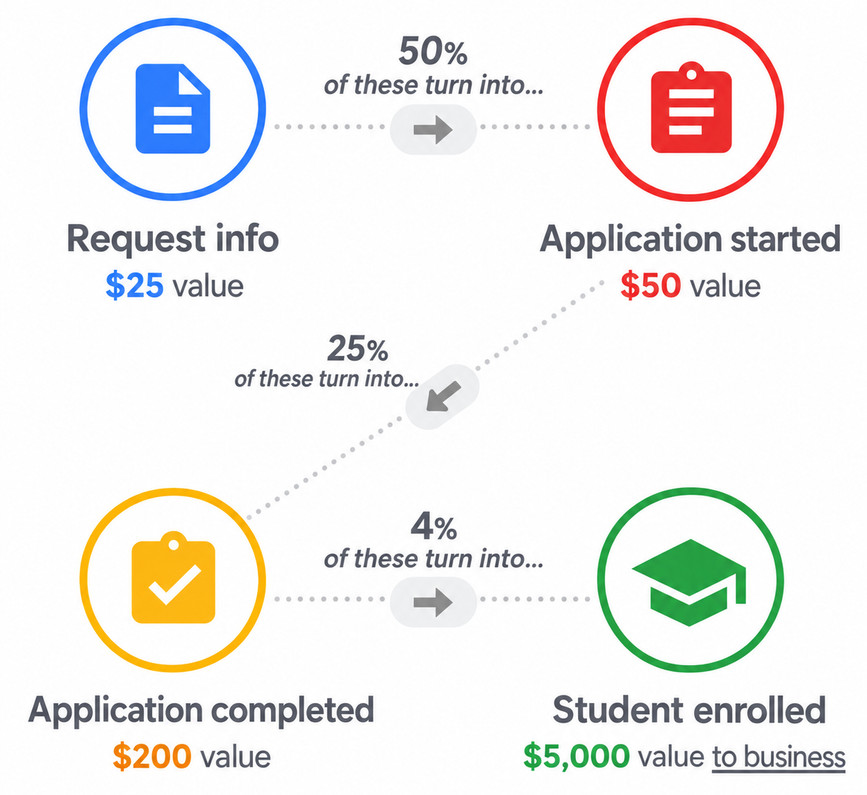
For example, an educational organization that values a “request for info” goal at $25, and a “started application” goal at $50 is telling the system that an application start is twice as valuable as an info request.
For HVAC and home performance companies, this could look something like:
- A basic contact form gets a certain value assigned
- A phone call gets 3x the value of that contact form
- Maintenance renewal conversion gets 10x the basic contact form value
- A new system installation conversion is assigned the highest conversion value of all actions
Unless you are using actual business revenue numbers, the numeric value of the goal itself does not really matter. What matters is the relative value of that goal compared to other types of goals. The information you feed the system about the calibrated values of different conversions also opens up the option to use more nuanced bidding strategies, like Maximize Conversion Value or Target ROAS, that work to get you not just the most conversions, but the most conversion value.
Remember, the higher the quality of conversion signals you feed the system, the higher the quality of your outcomes.
Strategy 2: Offline Conversion Tracking
In a typical setup, analytics and advertising platforms measure and optimize toward front-end online conversions, like webform fills and phone calls. What happens beyond those front-end conversions isn’t readily available data for advertising platforms, aside from anecdotal info from sales reps about lead quality.
Offline Conversion Tracking (OCT) is a feature that allows advertisers to measure key actions that take place offline, for example, a “quote signed” conversion or a “deal closed” conversion. By building key offline conversions within digital advertising platforms, campaigns are able to capture data about the full scope of performance beyond the earlier stages of initial contact and form fill. This is especially helpful for HVAC and home performance companies, where a lot of business and closed deals happen offline, in repeat phone calls, in customers’ homes, etc.
OCT gives advertising systems more signals of different types of conversions, which is helpful for conversion-based bidding strategies. This can significantly help the bidding system optimize toward what’s working and what isn’t, since you’re getting a fuller, start-to-finish picture of lead performance. The specific setup for OCT looks different depending on which platform you use for customer management.
Strategy 3: Phone Call Tracking & Qualification
This is a big one: call tracking is very important for assessing lead quality and adjusting as necessary. Using a software like CallRail gives you super specific information on where your phone calls are coming from (both paid and unpaid sources), even down to the campaign and keyword that generated a particular call. Call tracking software will also record the calls, meaning you or a customer service rep can audit the calls to assess quality.
From there, you can make informed decisions about where quality calls are and are not coming from. This can inform important decisions like increasing a particular campaign budget, scaling back on phone call goals for a certain ad network, and a whole lot more.
Google also recently introduced AI qualified phone leads, which uses AI-powered filters to "remove non-qualified interactions such as robocalls, spam calls, and misdials that previously met the call duration threshold" (source). Prior to this, phone call conversions were counted based on call duration. If your inbound phone call exceeded a certain number of seconds, it automatically counted as a conversion. This new feature introduces a lot more nuance into the picture, automatically filtering out more spam and low-quality calls. This is another great way to give the platform better data by feeding higher-quality conversion signals into the bidding algorithm.
Bonus Tip: Use reCAPTCHA
This isn’t strictly related to digital advertising, but it’s important. ReCAPTCHA is a free Google tool that helps protect your website by blocking spam and bot activity. One version you’re probably very familiar with is the “I’m not a robot” checkbox you often need to click before submitting a webform. This can help cut down on spammy activity from all traffic sources. Be sure to implement this on your site if you haven’t already.
ClickToast Helps HVAC & Home Performance Companies Improve Lead Quality
At ClickToast, we help our clients create strategic digital advertising campaigns that go beyond the basics, using intelligent conversion signals to drive high-quality leads for your business.
Learn more about how our "ClickToast Local" solution is built specifically for local service businesses like HVAC professionals, home performance contractors, energy auditors, and home inspectors.
Contact ClickToast’s founder, Dana Pillsbury, at dana@clicktoast.com
Publicaciones recientes
-
Stop Feeding Google Bad Leads: Get Digital Advertising To Drive Revenue
A TruTech Tools exclusive article brought to you by: ClickToast Digital Advertising www.cli …13th Sep 2026 -

'Keep HVAC Local' Hat Sales Benefit the GRIT Foundation
WorkHero has launched the Keep HVAC Local campaign to raise money for the GRIT Foundation a …2nd Sep 2026 -

5 Essential HVAC Tools Technicians Reach for Every Day
Every technician has favorite tools, but some get used on nearly every service call. I don’t …16th Aug 2026