



Personal CO Monitors and Their Importance
Carbon monoxide (CO) is a byproduct of incomplete combustion that cannot be seen, smelled, or tasted. For HVAC professionals working around fuel-burning equipment, that makes a personal CO monitor is the one piece of test gear in the bag that protects the technician instead of the equipment.
A personal CO monitor measures carbon monoxide in the surrounding air and alerts the technician when CO reaches the monitor's alarm level. Worn on the body during a service call, not left in the tool bag, it provides ongoing monitoring before and during combustion testing. That includes the walk to the mechanical room and the time spent in the living space before an appliance is ever fired. The closer the monitor sits to your breathing zone, the closer its reading is to what you are actually inhaling.
Personal CO Monitor vs. Combustion Analyzer
A personal CO monitor and a combustion analyzer can both measure carbon monoxide, but they serve different purposes.
A combustion analyzer measures flue gas to help technicians evaluate combustion and appliance operation. Depending on the instrument, measurements can include oxygen, carbon monoxide, carbon dioxide, stack temperature, and draft. It answers a question about the appliance.
A personal CO monitor is focused on the technician's environment. It monitors the ambient air for CO while the technician is working. Most analyzers can read ambient CO too, but only while you are holding them and watching the screen. A personal monitor is on you for the whole call, and its alarm gets your attention without you having to look at anything. That's why a personal CO monitor complements a combustion analyzer rather than replacing it.
For a combustion testing setup, TruTech Tools recommends a combustion analyzer, personal CO monitor, draft gauge, and smoke pencil.
Choosing a Personal CO Monitor
Personal CO monitors differ in features, alarms, battery life, service requirements, and cost. The right choice depends in part on how the technician plans to use and maintain the instrument. The biggest split is between an alarm-only unit with no display and a monitor that shows a live ppm reading and can be calibrated.
For reference, NIOSH recommends keeping CO exposure under 35 ppm averaged over 8 hours, with a ceiling of 200 ppm that should never be exceeded. OSHA's permissible exposure limit is 50 ppm as an 8-hour average. Alarm points on personal monitors are set at or below those numbers on purpose, so an alarm at 20 or 35 ppm is a warning to start paying attention, not a sign you are already in trouble.
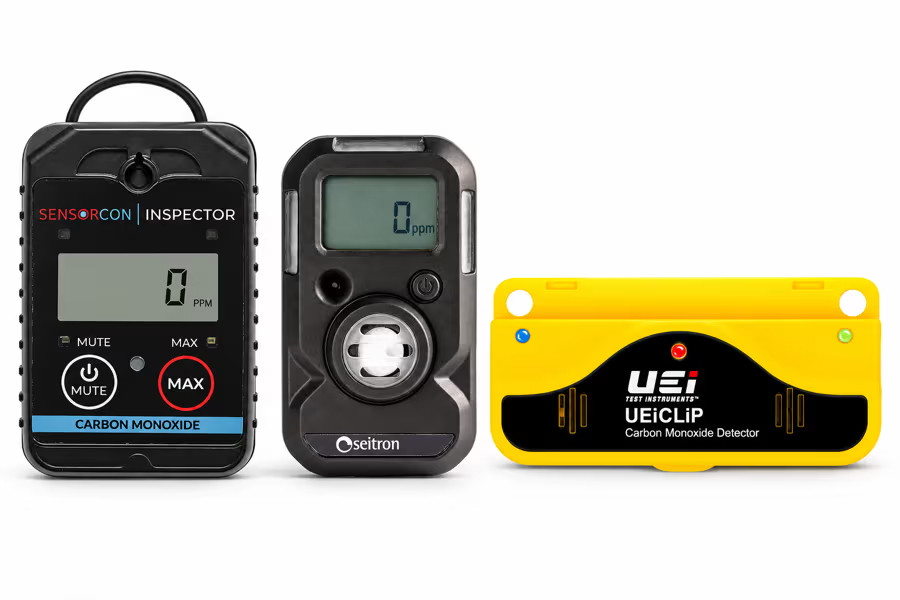
UEi CLiP Personal CO Monitor is the simplest option here. It is an alarm, not a meter: there is no numeric readout, just a heartbeat LED that confirms it is running, a red LED with an audible alert when CO goes above 20 ppm, and a yellow end-of-life light. The sensing range is 0 to 300 ppm. Pull the activation tab and it runs for up to two years. The battery is not user replaceable and there is no calibration, so when the end-of-life light comes on the unit gets replaced, not serviced.
Sensorcon Inspector Industrial Pro includes audible, visual, and vibrating alarms, adjustable alarm settings, and a 24-hour time-weighted average (TWA). It uses an electrochemical CO sensor and displays CO readings from 0 to 500 ppm. Factory alarm points match the NIOSH 35 ppm TWA and 200 ppm ceiling, and the low alarm can be set as low as 5 ppm for techs who want an early heads-up. The housing is IP67 rated. It can be field calibrated with cal gas, or sent to Sensorcon for calibration if you would rather not keep gas and a regulator on the truck.
The SENSIT P100 Personal CO Monitor measures CO from 0 to 999 ppm and provides audible, visual, and vibration alarms, along with short-term exposure limit (STEL) and time-weighted average (TWA) alarms. It also offers alarm-event memory and field calibration. Out of the box the TWA alarm is set at 50 ppm over 8 hours and the STEL alarm at 75 ppm. The memory holds up to 100 alarm events. Sensor and battery are rated for two years of continuous use, and the 4-year warranty version includes Sensit's refurbish program, which sends you a second two-year monitor when the first one reaches end of life.
An Important Part of Combustion Safety
A personal CO monitor doesn't replace proper combustion testing. Instead, it gives technicians a way to monitor the air around them for CO while they work.
Like other safety-related test instruments, personal CO monitors also need proper maintenance. Calibration requirements, battery life, sensor life, and end-of-life procedures vary by model, so technicians should follow the manufacturer's specifications for the monitor they use. A monitor that can be calibrated should also be bump tested with known gas on a regular schedule, and a disposable unit should be replaced the day its end-of-life light comes on, not a month later.
Before choosing a monitor, compare its detection range, alarms, battery and sensor life, calibration requirements, and service options, and decide whether you want a live reading or just an alarm, to find the best fit for your work. Explore our full range of Personal CO Monitors.
Recent Posts
-
Personal CO Monitors and Their Importance
Carbon monoxide (CO) is a byproduct of incomplete combustion that cannot be seen, smelled, …8th Oct 2026 -

Stop Feeding Google Bad Leads: Get Digital Advertising To Drive Revenue
A TruTech Tools exclusive article brought to you by: ClickToast Digital Advertising www.cli …13th Sep 2026 -

'Keep HVAC Local' Hat Sales Benefit the GRIT Foundation
WorkHero has launched the Keep HVAC Local campaign to raise money for the GRIT Foundation a …2nd Sep 2026